• Skip to secondary menu
  • Skip to main content
  • Skip to primary sidebar
  • Skip to footer
  • HOME
  • About
  • The Rules
  • Technology
  • Terminology
  • Lessons Learned
  • About Me
  • The UGLY

Feathers and Fuzz

one woman's cure for the empty-nester blues

  • Index of Posts
  • Meet the Feathers
  • Meet the Fuzz

House Finch

Raising a House Finch Family

June 20, 2018 by MoJo

Being an observer of "Raising a House Finch Family" on camera has been quite the experience.  Obviously, the whole Cowbird nightmare was a piece of it.  What has been equally-educational to me is how different a Finch family is from the other songbirds who have nested on camera.

Finch Nesting Differences

  • Fresh, green plant material is used in nest construction.  The other nests I have observed contain only non-green material.
  • The nest cup is shallower and much more-loosely "thrown" together.  (The bottom to the current nest on my property is completely pushed away.  The nestlings are resting on the bare wood of the platform.  Makes me wonder what would happen if this nest were on a branch!)
  • The female parent spends considerably more time sitting on the nest -- almost constantly during incubation and well-into the first week of the nestlings' lives.
  • It appears the female parent's primary nourishment comes from her mate feeding her -- compared to the male providing an occasional meal to the female.
  • The male parent also appears to take primary responsibility for feeding the nestlings -- a duty shared by my other on-camera songbird parents.
  • Nestlings are fed almost exclusively a vegetarian diet -- quite the contrast to the mealworm-feasting families inhabiting my other nest sites.
  • The parent eats the plant/seed material and then regurgitates it when feeding the nestlings -- hmmm -- some similarity to cows here.  I wonder if that's what attracts the Cowbirds?!  (Okay, I don't really wonder that.)  Regurgitation behavior has not been observed among the other nesting species.
  • The shape of the nestlings' beaks is also quite different -- much narrower; almost heart-shaped -- not broad and triangular like the others.
  • It strikes me how the two nestlings in this brood commonly eat with their beaks touching each other.  It's a striking difference from the other species' nestlings whose only goal in life is to reach closest to the incoming food.
  • Finally, I don't know what it is about Finches and their busy-body nature!  Poor Mom and Dad Finch spend considerable time chasing off other Finches (mostly female) who feel compelled to stop and stare at the nest/nestlings.
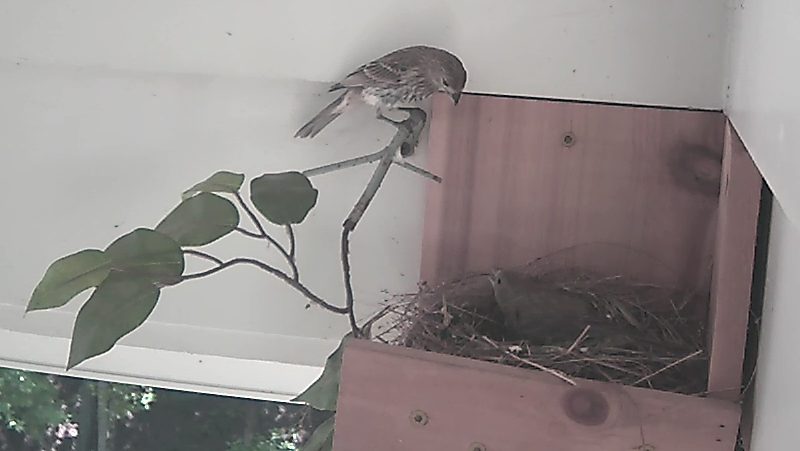
 

Foreign Female Finch Visits Finch Nest

Foreign Finch Visits House Finch Nest

In the feature video, you will see Dad House Finch feeding his offspring on two different occasions.  Note that Mom Finch is on the nest in the first feeding and she appears to duck out of the way while Dad does the feeding.  In between the two feedings, yet-another visitor arrives to stare at the nest and nestlings.  You'll see one nestling begin to respond to the visitor's presence with open beak, but appears to quickly realize this is a foreign species and backs away.  In the second feeding, Dad dares to turn his back after he arrives with lunch and at least one nestling is quite unhappy about it.

https://www.feathersandfuzz.com/wp-content/uploads/2018/06/Finch-Family-Video.m4v

Filed Under: All the Others, Feathers Tagged With: House Finch, House Finch Nestlings, Male Finch Feeding Nestlings, Phoebe Visits Finch Nest

Brown-headed Cowbird Brood Parasitism

May 27, 2018 by MoJo

In a post last October, I talked about the Brown-headed Cowbird brood parasitism.  I talked about dreading the day I witnessed this parasitism on camera — tortured by what, if anything, I would do about it.  Well … that day came on March 21.  The House Finch nest I was so excited about was the scene.  (As a quick recap, Cowbirds do not raise their own young.  They lay their eggs in other bird’s nests … typically one egg per nest …. then leave the host parents to raise the nestling.)

Decisions Decisions

Although it is against the law to remove a Cowbird egg, I was ready to do whatever it took to protect the Finch and her brood.  After some research, however, I was quickly educated in the Law of Unintended Consequences (LUC).  A study was done, legally, in which the Cowbird’s egg was removed from some nests and left in others.  It turns out, the Cowbird may retaliate if her egg is removed — destroying the host’s own eggs.  In the study, the nests in which the Cowbird egg was removed faired worse than the untouched nests.  Great.

I then came up with what I thought was a brilliant plan — take the Cowbird egg out at dusk — and freeze it.  Then, return the no-longer-viable egg to the nest at dawn.  The LUC hung over my head — that and I vowed to do no harm.  I reminded myself that these birds are not of my creation.  I got myself back in the box.  Decision made.

The Scene

On March 20, I noticed that the Finch nest no longer had two eggs — just one remained.  I played back the video — and there was the Cowbird removing an egg in preparation for placing her own egg in the nest.  Early the next morning, the Cowbird reappeared.  She was ready to lay her egg — except — the mother Finch was on the nest and was not having it!  Although only half the size of the Cowbird, the Finch held off the Cowbird for 9 minutes.  The Finch was ultimately pushed aside, but stayed with her nest.  Unlike the labor video of the Eastern Bluebird, the Cowbird literally shot her egg into the nest and took off — the whole laying process taking just 10 seconds.  I love the fact that the Finch lunged forward and gave the departing Cowbird one more peck!

Today the nest contains 4 eggs — 3 Finch eggs and 1 Cowbird.  In many cases, since the Cowbird picks on smaller birds, only the Cowbird nestling survives.  In this case, however, there may be a different outcome.  Cowbird nestlings in Finch nests don’t fare well.  Cowbird nestlings rely on a protein diet, while Finch nestlings are fed plant matter.  Either way, I do not like it.

But — I do like witnessing the valor of motherhood as the Finch protects her nest.  At the end of the day, that is the uplifting takeaway from this whole experience.

https://www.feathersandfuzz.com/wp-content/uploads/2018/05/Parasitism-Video.m4v

Filed Under: All the Others, Feathers Tagged With: Brood Parasitism, Brown-headed Cowbird, House Finch

  • « Go to Previous Page
  • Page 1
  • Page 2
  • Page 3
  • Go to Next Page »

Primary Sidebar

Feathers and Fuzz Welcomes You!

Founded by MoJo:  Lover of mothering, chocolate, and red wine.  The order of these varies depending on the day.

2020 On-Camera Statistics

Want New Posts Delivered to Your Inbox?

Get Social & Follow Us On

Archives

Recent Posts

  • Don’t You Just Hate It…When Your Breakfast Can Fly?! March 15, 2020
  • Boy Meets Girl. Northern Flicker Return – Part 2 March 8, 2020
  • Northern Flicker Return – Part 1 March 1, 2020
  • Intermission February 24, 2020
  • Night Crawler – Rat Snake on the Prowl June 2, 2019

Footer

Contact Us*

Get Social & Follow Us On

This is the day the Lord has made; let us rejoice and be glad in it. Psalm 118:24

See "First Blog"

Copyright © 2026 Feathers and Fuzz